
Offered through Stanford University’s Center for Compassion and Altruism Research and Education (CCARE), the CCARE Compassion Lab is a pioneering 4-month immersive training designed to awaken and deepen the transformative power of compassion in all areas of life. This program equips individuals with evidence-based tools to navigate life’s complexity with resilience, clarity, and purpose. Participants will not only understand compassion intellectually, but embody it in ways that enhance personal well-being, relational depth, and professional leadership.

Phase One | Kickoff Retreat: Coming Home to Compassion
At the inaugural retreat, participants will explore the inner foundations of compassion—grounded presence, innate compassion, and self-compassion—as the basis for accessing and extending compassion to others. Drawing on the insights of contemplative traditions and compassion research, students will engage in embodied practices, interpersonal inquiry, and relational attunement exercises to deepen their capacity for self-compassion and extending compassion to others. This retreat marks the start of the required Compassion Blueprint and Peer-Compassion Pods, providing a structured, collaborative environment wherein participants set individualized learning goals across multiple domains.
Learning Objectives (click to expand)
- Demonstrate the ability to access and sustain self-compassion as a foundation for extending compassion to others
- Identify common blocks to self-compassion, including imposter syndrome and harsh inner criticism
- Apply evidence-based tools to access and maintain self-compassion under stress
- Practice compassionate connection and relational attunement skills with others
- Create collaborative peer-compassion pods grounded in mutual trust, support, and accountability
Phase Two | Steady in the Storm: Compassionate Self-Regulation

Participants will strengthen their ability to identify, understand, and effectively manage early signs of emotional reactivity and distress that block access to compassion. They will practice self-regulation techniques to sustain clarity, presence, and compassion in high-pressure situations.
Learning Objectives (click to expand)
- Identify precursors to emotionally reactive states and discern how these block access to compassion for self and others
- Explore the role of self-regulation strategies in sustaining compassionate presence during difficult situations
- Learn and apply targeted compassionate-regulation techniques in real time
- Integrate the relationship between self-regulation, ethical decision-making and compassionate action
Phase Three | Courageous Compassion: Ethical Engagement & Skillful Boundaries
Participants will explore how compassion and courage work together in setting healthy, ethical boundaries in their lives, workplaces, and communities. Drawing from research on conflict transformation, fierce compassion, and ethical leadership, participants will practice interventions for maintaining compassion for self and others amid challenging situations or difficult conversations. This phase synthesizes research with practical action, allowing participants to develop a repertoire of compassionate interventions that safeguard dignity while addressing harm.
Learning Objectives (click to expand)
- Distinguish between empathic distress, passive acquiescence, and courageous compassion
- Apply courageous compassion and implement healthy boundaries in response to harmful or unhealthy dynamics
- Demonstrate skillful delivery of difficult messages with clarity and compassion
- Design compassionate intervention strategies that balance relational connection with ethical action.
Phase Four | Beyond ‘Us’ and ‘Them’: Expanding the Circle of Compassion
Participants will examine the barriers to accessing compassion in situations of conflict, division, and polarization. Drawing from empathy research and the neuroscience of bias, participants will develop their understanding of the ways that in-group/out-group dynamics, dehumanization, and selective “othering” inhibit compassion. Participants will practice perspective-taking skills and engage in facilitated dialogue to build bridges across differences. The emphasis of this phase will be on sustaining compassion and respectful engagement with others when dealing with differences and disagreement.
Learning Objectives (click to expand)
- Identify the factors that inhibit compassion across group boundaries
- Practice perspective-taking skills to stay anchored in compassionate responses amidst differences
- Demonstrate tolerance for differing beliefs and apply strategies to consistently respect the dignity and humanity of all persons
- Apply compassion-based strategies to promote constructive dialogue in contexts of division

Phase Five | Heart as Wide as the World: Compassion as a Way of Life
Participants will integrate the theoretical and applied dimensions of compassion into a sustainable, lifelong practice where compassion becomes a default response in daily life. In this final training phase, participants will present their Compassion Blueprint: the culminating element of the CCARE Compassion Lab. The Compassion Blueprint is designed as a personal, yet outwardly impactful plan, that reflects each participant’s unique journey of inner transformation and collective change. This personal blueprint demonstrates how compassion has taken root in three interconnected domains:
- Compassion for Self — practices and commitments that sustain self-care, resilience, and self-compassion.
- Compassion for Others — relational practices such as empathic listening, compassionate communication, and authentic connection.
- Compassion in Context — a compassion-based initiative in a family, workplace, community, or other setting.
Through these presentations, the CCARE Compassion Lab community bears witness to each individual’s transformation, while also sharing collective wisdom for living and applying compassion in diverse settings.
Closing graduation retreat activities will focus on strategies for sustaining compassion, resilience, integration of practices, and the cultivation of a committed CCARE Compassion Lab community.
Learning Objectives (click to expand)
- Integrate neuroscientific, psychological, and contemplative approaches to compassion into a personal lifelong blueprint
- Design strategies for sustaining resilience and compassion beyond the program
- Create a sustained CCARE Compassion Lab community for ongoing support and collective impact
- Demonstrate the ability to respond to self and others with skillful, sustainable compassion and apply these practices in both personal and professional contexts.
Registration for the 2027 Cohort will open in September 2026.
If you’d like to hear more about our next cohort, we invite you to join our interest list and we’ll share more when it’s available.
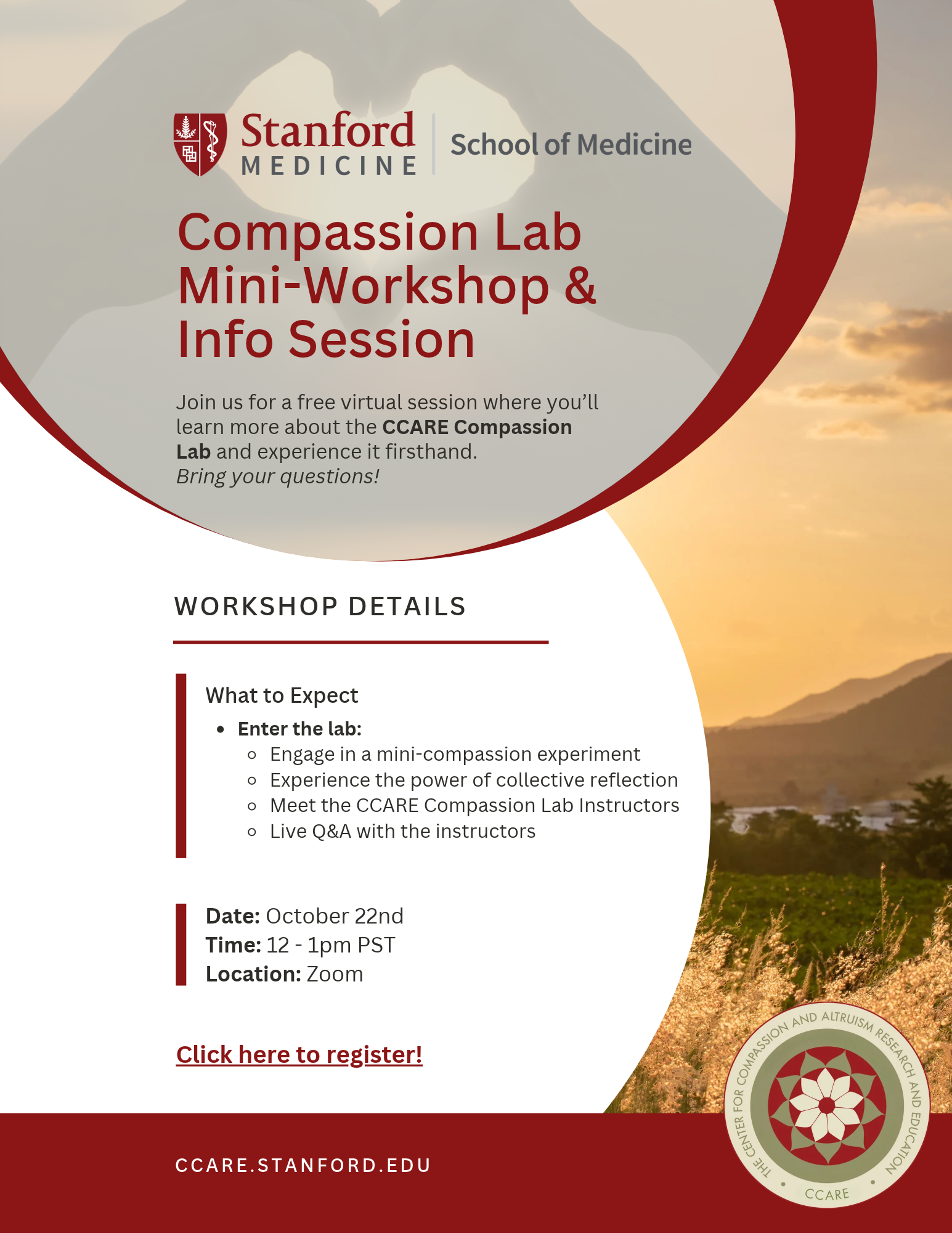
Save the Date!
CCARE Compassion Lab
Mini-Workshop & Info Session
Thursday, October 22nd
12pm – 1pm Pacific Time on Zoom
The session will be recorded and sent to those who register.